

Mainland Chinese businesses increase digitalisation despite tech gap
- Written by Telegraph Magazine
BEIJING, MAINLAND CHINA - Media OutReach - 25 August 2022 - Nine out of 10 accounting and financial professionals in Mainland China believe their employer will increase technology use over the next 12 months.
However, there is a digital divide between large and small businesses according to CPA Australia's Business Technology Survey 2022. 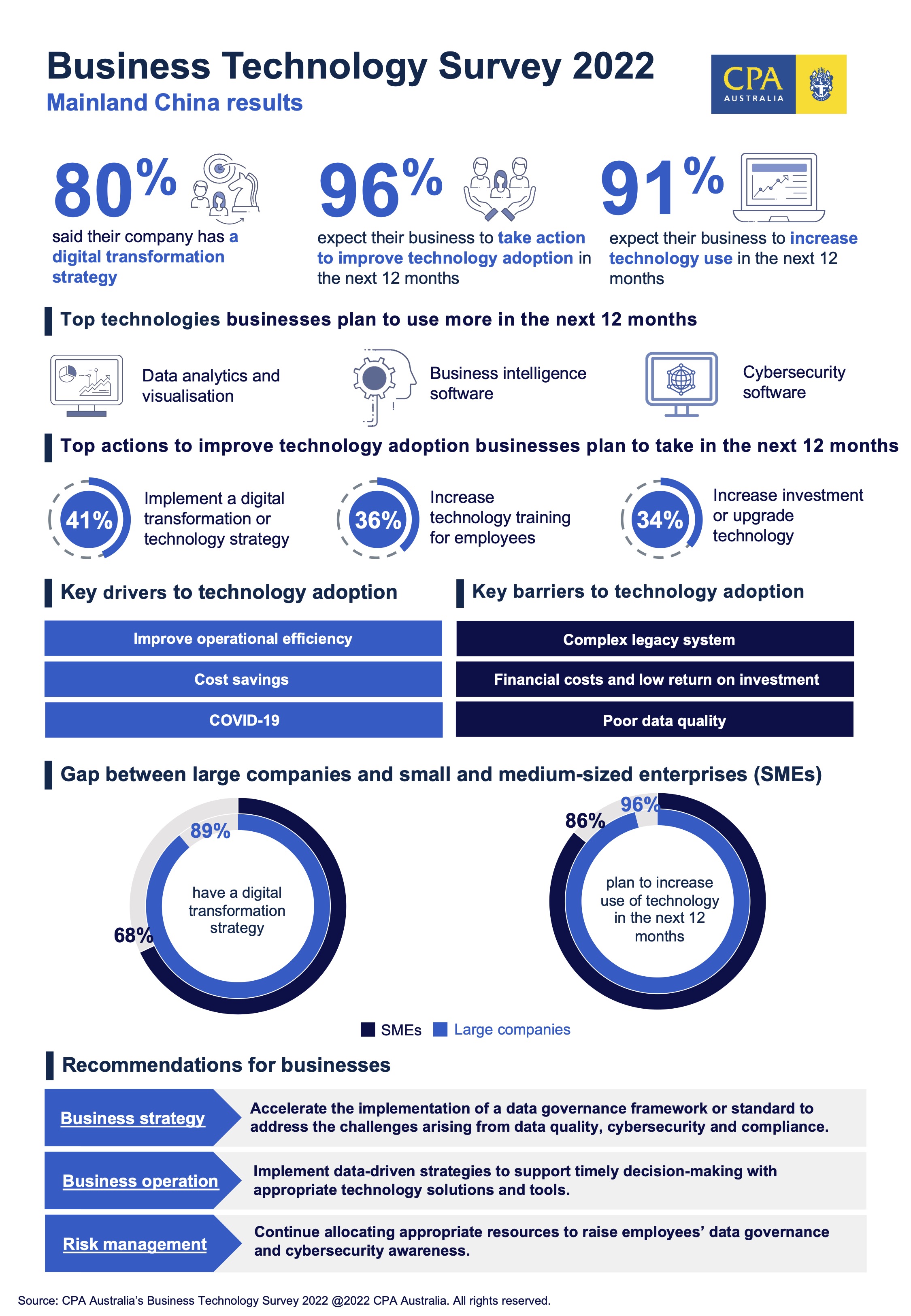
Eighty per cent of Mainland Chinese respondents reported that their company has a digital transformation strategy. Ninety-six per cent expect their businesses will take action to improve digitalisation in the next 12 months, which includes expecting their organisation to start or continue implementing of a digital transformation strategy (41 per cent).
CPA Australia, one of the world's largest professional accounting organisations, surveyed 820 accounting and financial professionals in seven Asia-Pacific markets, including 186 respondents from Mainland China.
Tony Chan FCPA (Aust.), Deputy President of CPA Australia's South China Committee, said businesses are accelerating digitalisation and taking practical steps to drive their competitiveness in the technology landscape.
"The survey results reflect the high-quality growth of the digital economy in Mainland China with many businesses keen on exploring innovative solutions to fuel data-driven growth."
"Mainland Chinese businesses are stepping into a new milestone of digital transformation by translating vision into action. I believe businesses will further improve their operational efficiency and profitability by integrating more technologies into all organisational functions in the future."
When asked what technologies respondents expect their organisation to use more in the next 12 months, data analytics and visualisation software (39 per cent) was the highest ranked. This is the second consecutive year this technology has topped the list. Business intelligence software (34 per cent) and cybersecurity software (29 per cent) were also top priorities.
"Data is the foundation of the digital economy. It's positive to see so many companies enthusiastic about using and analysing data to gain valuable insights and assist in decision-making. Cybersecurity is also on their radar, as many are taking measures to protect their data assets," Chan said.
However, the survey found a technology adoption gap among Mainland Chinese companies of different sizes. Over 30 per cent of respondents from small and medium-sized enterprises (SMEs) do not have a digital transformation strategy, compared to only 11 per cent of respondents from larger companies. Fourteen per cent of surveyed respondents working in SMEs said their company will not increase the use of any technologies in the next 12 months compared to only four per cent of respondents from large companies.
"There is a digital chasm between large companies and SMEs," said Collin Jin FCPA (Aust.), Member of CPA Australia's East and Central China Committee.
"SMEs are the backbone of the Chinese economy and supporting them to adopt the right technologies and turn investments into return is critical. We appreciate government's policy support such as R&D tax incentives and VAT credit refund programs for SMEs which may encourage them to continue their investment in digitalisation. We recommend SMEs consider looking at low-hanging technologies in the market, such as intelligent automation and SaaS applications," Jin said.
As China's digital economy matures, enterprises are facing new challenges. The survey shows that complex legacy systems (37 per cent), financial costs and low return on investment (34 per cent) and poor data quality (31 per cent) are the key barriers to technology adoption in Mainland China.
"The percentage of Mainland Chinese respondents identifying complex legacy system and poor data quality as key barriers to technology adoption is noticeably higher than the survey average. This implies that while many businesses have started their journey of digitalisation, older systems may be a hindrance to the collection of quality data and to the adoption of advanced technologies," Jin said.
"To address these challenges companies should regularly review their IT infrastructure and systems to ensure they meet internal and external requirements. When updating systems or software, it's better to select appropriate technologies to align with the company's long-term goals."
"To improve data quality, we recommend companies establish an effective data governance mechanism and framework. Companies need to ensure they can accumulate and collect relevant data across different departments in an efficient and collaborative manner while meeting compliance requirements. This means companies need to put in place comprehensive and practical data policies and procedures for employees."
Download CPA Australia's Business Technology Report 2022 (English only)
Hashtag: #CPAAustralia
About CPA Australia
CPA Australia is one of the largest professional accounting bodies in the world, with more than 170,000 members in over 100 countries and regions, including more than 22,200 members in Greater China. We have offices in Beijing, Shanghai and Guangzhou. CPA Australia provides thought leadership on local, national and international issues affecting the accounting profession and public interest. We engage with governments, regulators and industries to advocate policies that stimulate sustainable economic growth and have positive business and public outcomes. Find out more at cpaaustralia.com.au


