


PolyU harnesses GeoAI technologies to enable sustainable urban development
- Written by: Telegraph Magazine
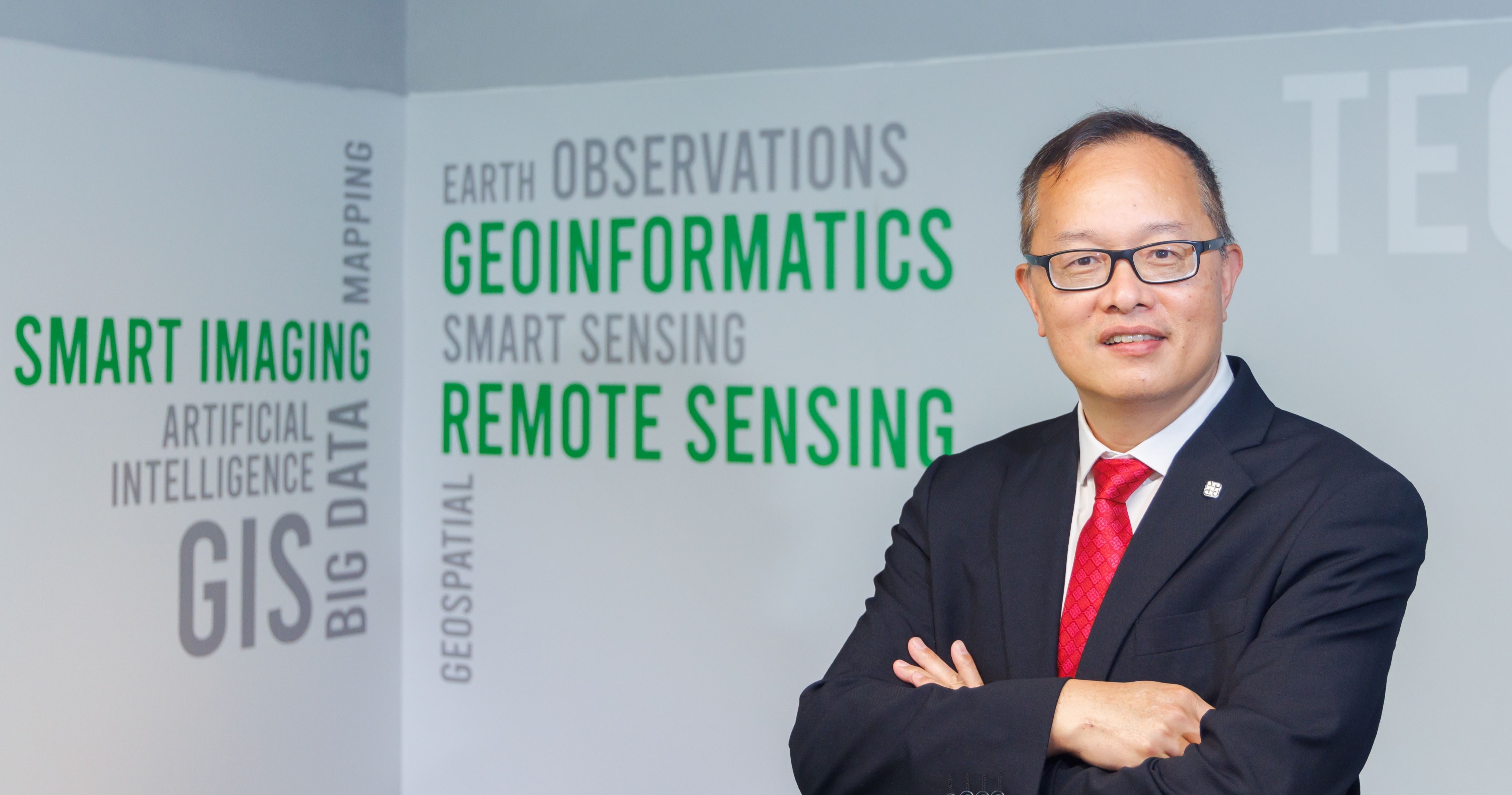
Prof. Qihao Weng, Chair Professor of Geomatics and Artificial Intelligence of the Department of Land Surveying and Geo-Informatics, and Global STEM Professor, is also the Principal Investigator and Director of the PolyU Research Centre for Artificial Intelligence in Geomatics.
Prof. Qihao WENG, Chair Professor of Geomatics and Artificial Intelligence of the Department of Land Surveying and Geo-Informatics, and Global STEM Professor, established the PolyU Research Centre for Artificial Intelligence in Geomatics (RCAIG), to focus on the development of original and innovative AI methodologies and technologies for geomatics and their applications in urban areas, with the goal of it becoming a global R&D hub in GeoAI. Prof. Weng has recently been honoured with the 2024 American Association of Geographers (AAG) Wilbanks Prize for Transformational Research in Geography and the 2024 AAG Remote Sensing Specialty Group Lifetime Achievement Honor Award for his ground-breaking contributions in geography.
One direction for the Research Centre is investigation into human-environment interactions in urbanisation by utilising geospatial analytics, GeoAI and big data methods. Another direction is to create various data products of global urban areas using Earth Observations (EO) and to provide EO-based urban data services.
As RCAIG Principal Investigator and Director, Prof. Weng said, "Earth observation is important as a guiding compass for understanding changes in the environment and society. Our research focuses on diverse fields including geospatial big data and AI, remote sensing, ground-based sensors, navigation and positioning, surveying and geodesy, laser scanning, and photogrammetry. These technologies play a crucial role in addressing and resolving key environmental and social challenges."
In particular, GeoAI has revolutionised building monitoring by utilising thousands of learnable parameters. An illustration of this is its ability to automatically learn and identify general patterns of buildings such as colour and shape. This technology is crucially applied to detect disaster-damaged buildings, retrieve building height, identify structural changes and estimate building energy consumption. As a result, GeoAI has emerged as a mainstream solution for more efficient and insightful building monitoring.
Environmental monitoring
In the field of urbanisation monitoring, an RCAIG research team has developed an impervious surface area based urban cellular automata (CA) model that can simulate the fractional change of urban areas within each grid by utilising annual urban extent time series data obtained from satellite observations. By categorising the historical pathways of urban area growth into different levels of urbanisation, the model offers more detailed insights compared to traditional, binary, CA models. This demonstrates its great potential in supporting sustainable development.
Research conducted by Ms Wanru HE, an RCAIG doctoral research assistant, and her team was reported in the paper "Modeling gridded urban fractional change using the temporal context information in the urban cellular automata model", and has been published in Cities. Their model effectively captures the dynamics of urban sprawl with significantly improved computational efficiency and performance, and will help enable the modelling of urban growth at regional and even global level, under diverse future urbanisation scenarios.
GeoAI for traffic management
In the area of smart traffic management, to enhance the efficiency of ride-hailing platforms and achieve intelligent management of their services, the RCAIG research team has developed a multi-agent order matching and vehicle repositioning approach. This innovative technology focuses on coordinating the supply and demand of ride-hailing services, ultimately aiming to improve their overall efficiency.
Their approach provides a ground-breaking solution to tackle two critical aspects necessary for efficient ride-hailing services. Firstly, it addresses order matching by efficiently assigning orders to available vehicles. Secondly, it incorporates proactive vehicle repositioning, strategically deploying idle vehicles to regions with potentially high demand.
Based on multi-agent deep reinforcement learning, this innovation solves the complex planning issues in transportation and offers a new perspective on a long-term spatio-temporal planning problem. The research conducted by Ms Mingyue XU, another RCAIG researcher, and her team, was reported in the paper "Multi-agent reinforcement learning to unify order-matching and vehicle-repositioning in ride-hailing services", and has been published in the International Journal of Geographical Information Science. The study achieved outstanding results, including reduced passenger rejection rates and driver idle time.
Hashtag: #polyu #GeoAI #sustainableurbandevelopment
The issuer is solely responsible for the content of this announcement.
About RCAIG
With a focus on GeoAI, RCAIG is dedicated to conducting research in diverse fields, including urban building and energy, urban safety and security, environmental monitoring and conservation, urban resilience and public health. This aligns with the 11th United Nations Sustainable Development Goal, which aims to create inclusive, safe, resilient and sustainable cities and human settlements. Website: https://rcaig.com/
Learn more about Prof. Qihao Weng's research focus in the video: https://polyu.me/3Vt7yih


