


CPA Australia Survey: Practical AI adoption and easier financing drive Taiwan SME confidence to a five year high
- Written by: Telegraph Magazine
TAIPEI, TAIWAN - Media OutReach Newswire - 30 March 2026 - More than half of Taiwan's small businesses recorded growth in 2025, while confidence heading into 2026 climbed to its highest level since 2020, according to the Asia-Pacific Small Business Survey 2025–26 conducted by global professional accounting body CPA Australia.
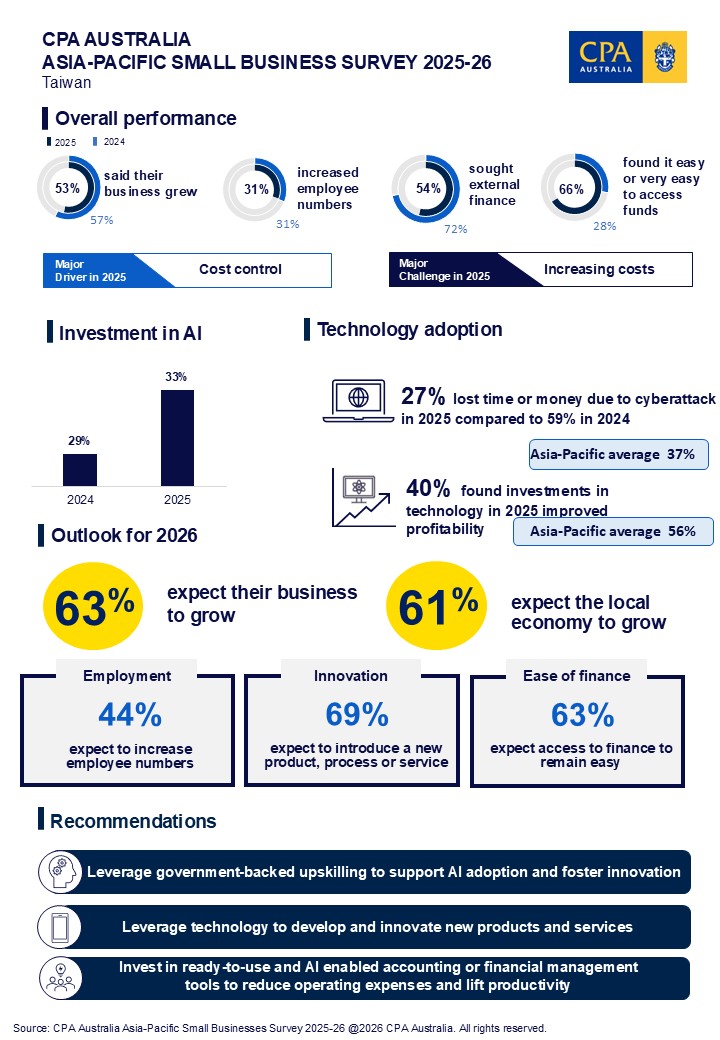
The survey found that 53 per cent of Taiwanese small businesses grew in 2025, slightly below the 57 per cent recorded in the previous survey. Looking ahead, business sentiment strengthened notably. In 2026, 63 per cent of respondents expect their business to grow, while confidence in the local economy also improved, with 61 per cent anticipating economic growth, the highest level recorded since Taiwan was first included in the survey in 2018.
Taiwan's small and medium‑sized enterprises (SMEs) continue to play a vital role in creating new jobs. In 2025, 31 per cent of SMEs increasing staff numbers, while 44 per cent plan to hire additional employees in 2026.
With rising costs identified as the biggest challenge facing Taiwan's SME in 2025, many businesses identified cost control as the most positive contributor to business performance last year.
Mr Elic Lam FCPA (Aust.), Honorary Taiwan Advisor at CPA Australia, said Taiwan's economic fundamentals continue to support small business resilience, "Rising global demand for semiconductors and AI related chips continues to create opportunities for exporters and suppliers across Taiwan's value chain," Mr Lam said. "While geopolitical tensions and intensifying competition are adding uncertainty, government support measures for SMEs, including targeted subsidies and tax incentives, together with Taiwan's resilient domestic demand, are helping to lift business confidence."
Technology adoption, particularly artificial intelligence (AI), is becoming increasingly widespread among Taiwanese small businesses. The survey found that 33 per cent of small businesses identified AI as the technology they invested in most heavily invested in 2025, up from 29 per cent in the previous year.
Cyber risk among Taiwanese small businesses fell markedly. The share of small businesses reporting losses of time or money due to cyber incidents declined sharply from 59 per cent in 2024 to 27 per cent in 2025, reflecting stronger awareness and the uptake of basic protective measures across the sector.
However, the survey also indicates there is room to strengthen the returns from digital investment. Only 40 per cent of respondents reported that their technology investment in 2025 improved profitability, compared with the survey average of 56 per cent.
Mr Lam noted that Taiwan's SME sector is undergoing a generational transition that is influencing technology adoption patterns, "Many SMEs in Taiwan are moving from first generation ownership to second or third generation leadership, and technology adoption remains cautious and practical," he said. "The increase in AI investment reflects both external drivers, such as changing customer expectations and government policy support for digital transformation, as well as internal factors, including younger owners' familiarity with AI tools and rising operating and staffing costs."
"To improve profitability, SMEs should focus on applying digital solutions in areas with the greatest impact. For example, as rising costs were identified as the most negative factor affecting performance in 2025, investing in ready-to-use and AI enabled accounting or financial management tools can help reduce operating expenses and lift productivity."
Access to finance is another notable finding. Financing conditions in Taiwan improved significantly in 2025, even as borrowing softened. Two-thirds of businesses (66 per cent) I said it was easy to access external finance, placing Taiwan among the top three surveyed markets and representing a sharp increase from 28 per cent in 2024. Looking ahead, financing conditions are expected to remain supportive, with 63 per cent anticipating easy access to finance in 2026.
Despite the marked improvement in financing conditions, demand for finance was more subdued. In 2025, 54 per cent of SMEs sought external finance, down from 72 per cent in 2024.
"The Taiwan government has expanded inclusive and guaranteed financing mechanisms to support SMEs, including higher guarantee ratios under the SME Credit Guarantee Fund and preferential loans offered through state affiliated banks," Mr Lam said. "These measures have made bank financing more accessible for small businesses."
"Even so, many SMEs remain cautious about taking on new debt. In a stable domestic environment, businesses can maintain steady growth, but external uncertainties drive them to take a prudent approach to borrowing. This aligns well with the government's policy focus on gradual and resilient SME transformation rather than rapid, high risk expansion."
Lam concluded, "To navigate international uncertainty and intensifying market competition, Taiwan's small businesses should make better use of government policy support to upskill their workforce through AI adoption, foster innovation, and diversify export markets by strengthening online sales channels."
The Asia Pacific Small Business Survey 2025–26 gathered views from 4,166 small businesses across 11 markets in the region, including Singapore, Chinese Mainland and Australia. The Taiwan survey sample comprised 311 small businesses.
Hashtag: #CPAAustralia
The issuer is solely responsible for the content of this announcement.
About CPA Australia
CPA Australia is Australia's leading professional accounting body and one of the largest in the world. We have more than 176,000 members in over 100 countries and regions, including more than 22,500 members in Greater China. Our core services include education, training, technical support and advocacy. CPA Australia provides thought leadership on local, national and international issues affecting the accounting profession and public interest. We engage with governments, regulators and industries to advocate policies that stimulate sustainable economic growth and have positive business and public outcomes. A CPA is a Certified Practising Accountant. More at  cpaaustralia.com.au


