

Why More Facilities Are Switching to Compressed Air Poly Pipe
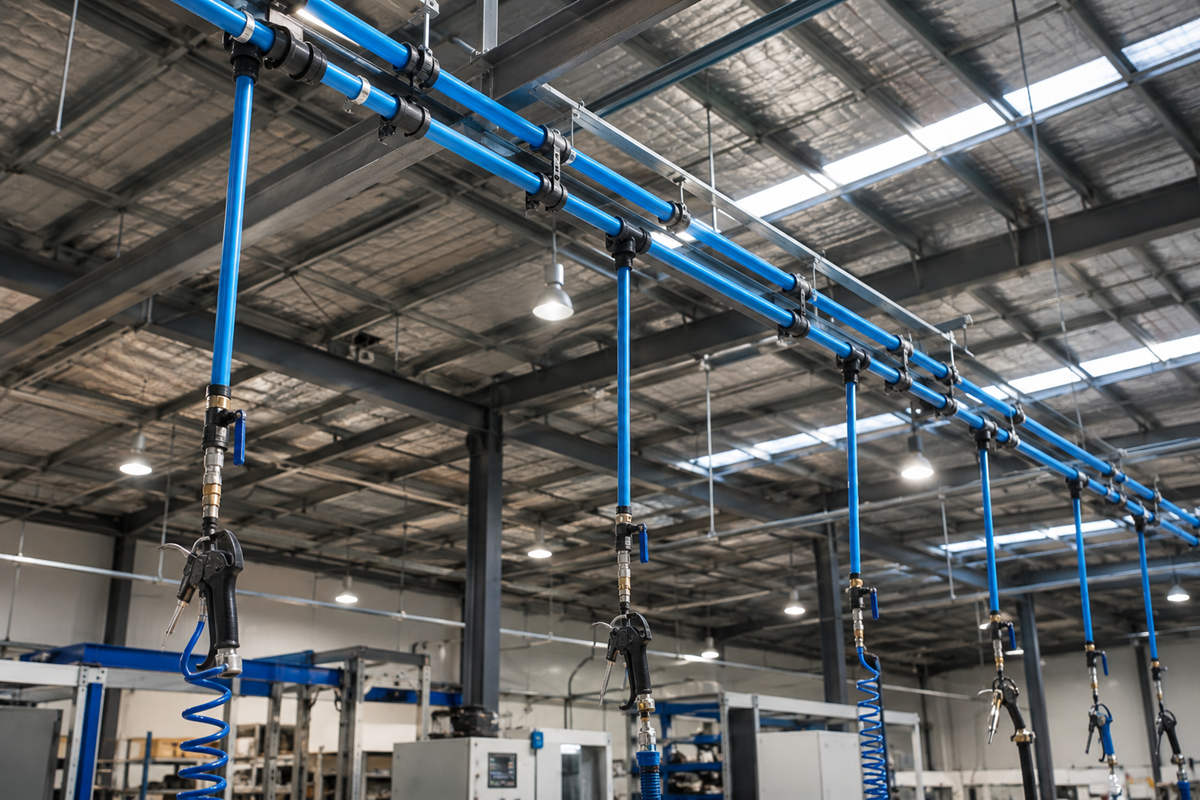
Compressed air is often called the "fourth utility" in industrial facilities, right alongside electricity, water, and gas, yet the pipework carrying it rarely gets the same attention until something fails. For decades, black steel and galvanised pipe were the default choice for compressed air distribution across warehouses and factories. That's changing fast. Compressed air poly pipe has become the preferred option for a growing number of facility managers, engineers, and plumbers, and the reasons go well beyond simply being lighter to carry up a ladder.
This article looks at why poly pipe has gained ground so quickly in compressed air applications, what actually matters when specifying a system, and where the traditional steel approach still falls short by comparison.
The Problem With Traditional Steel Compressed Air Lines
Steel pipework has been the industry default for compressed air for so long that its downsides are often accepted as simply part of the job. Internal corrosion is the biggest one. Moisture is an unavoidable by-product of compression, and even with good dryers and filtration in place, steel pipe corrodes from the inside over time. That corrosion doesn't just weaken the pipe; it flakes off and travels downstream, contaminating tools, pneumatic equipment, and any process that relies on clean air.
Installation is the other pain point. Steel compressed air lines require threading, welding, or heavy fittings, all of which add labour time and cost to any new run or modification. Reconfiguring a steel system when a factory floor layout changes is a genuinely disruptive job, often requiring line shutdowns and skilled tradespeople for what should be a straightforward relocation.
Then there's the efficiency cost. As internal corrosion roughens the bore of a steel pipe, friction losses increase, meaning compressors have to work harder to deliver the same pressure at the point of use a hidden energy cost that compounds for as long as the corroded pipework stays in service.
What Makes Poly Pipe a Better Fit for Compressed Air
Poly pipe systems address most of these problems directly, which explains why uptake across industrial supply channels has accelerated so quickly.
- No internal corrosion — poly pipe simply doesn't rust, meaning air quality stays consistent for the life of the installation
- Smooth internal bore — this stays smooth indefinitely, unlike a corroding steel line, which keeps friction losses low and preserves system efficiency
- Push-fit connections — most poly systems use quick-connect fittings rather than threading or welding, cutting installation time dramatically
- Lightweight handling — a single technician can run and modify lines without the lifting equipment steel often demands
- Modular reconfiguration — moving or extending a line is a matter of adding fittings rather than re-threading or re-welding sections
For facilities that regularly reconfigure floor layouts a common reality in warehousing and light manufacturing this modularity alone can justify the switch. What might take a full day with steel pipework can often be completed in an hour or two with a properly designed poly system.
Sizing and Pressure Ratings: What Engineers Need to Check
Not every poly pipe product is rated the same way, and getting this wrong is the most common mistake in compressed air specification. Pressure rating, temperature tolerance, and bore diameter all need to be matched to the actual demand of the system, not just the nominal size of the existing pipework being replaced.
Undersized bore diameter is a particularly common oversight. It's tempting to match the old steel pipe's nominal size exactly, but because poly systems often have a genuinely smoother internal surface, a slightly smaller bore can sometimes deliver equivalent or better flow while an undersized system paired with high-demand tools will cause pressure drop at exactly the moment it's needed most. Working through actual compressor output, total line length, and the peak simultaneous demand of connected tools gives a far more reliable basis for sizing than simply matching old pipe dimensions.
Temperature exposure matters too. Poly pipe run near compressors, in direct sun, or adjacent to other heat-generating equipment needs a rating that accounts for that exposure, since performance characteristics can shift outside the manufacturer's specified temperature range.
Installation Best Practice for Long-Term Reliability
Even with a simpler installation process than steel, a handful of practices separate a poly compressed air system that performs reliably for years from one that develops problems early.
Supporting the pipe at correct intervals prevents sagging, which over time can create low points where moisture collects rather than draining as designed. Running lines with a slight fall toward drain points, rather than dead level, helps condensate move away from tool connections instead of pooling at low spots in the system.
Fitting selection matters as much as the pipe itself. Mixing fitting brands or types within a single system, rather than using components designed to work together, is one of the more common causes of slow leaks that go undetected for months, quietly costing compressed air efficiency the entire time. A well-specified compressed air poly pipe system should be planned as a complete kit: pipe, fittings, and accessories all rated and designed to work as one system rather than pieced together from whatever happens to be on hand.
Labelling and documentation, while not glamorous, save enormous time during future maintenance. A clearly marked system with recorded run lengths and connection points means any future modification or fault-finding starts from a position of knowledge rather than guesswork.
Comparing the Total Cost, Not Just the Purchase Price
Facility managers evaluating poly pipe against steel purely on upfront material cost are missing most of the picture. The comparison that actually matters spans installation labour, ongoing maintenance, energy efficiency over the system's lifetime, and the cost of downtime during future reconfiguration.
Steel systems often look competitive on the shelf price of the pipe itself, but the labour-intensive installation process, the corrosion-driven maintenance burden, and the efficiency losses that build up over years frequently tip the total cost of ownership in poly's favour, sometimes significantly so, particularly in facilities that expect to modify their floor layout more than once or twice over the system's working life.
Final Thoughts
Compressed air poly pipe isn't simply a lighter alternative to steel; it's a genuinely different approach to distributing what many facilities treat as their most overlooked utility. Corrosion-free performance, faster installation, and long-term efficiency gains add up to a compelling case, provided the system is sized correctly and installed with the same care any critical utility deserves. For engineers and plumbers weighing up their next compressed air project, understanding these fundamentals before specifying a system is what separates a smooth installation from a recurring maintenance headache.


